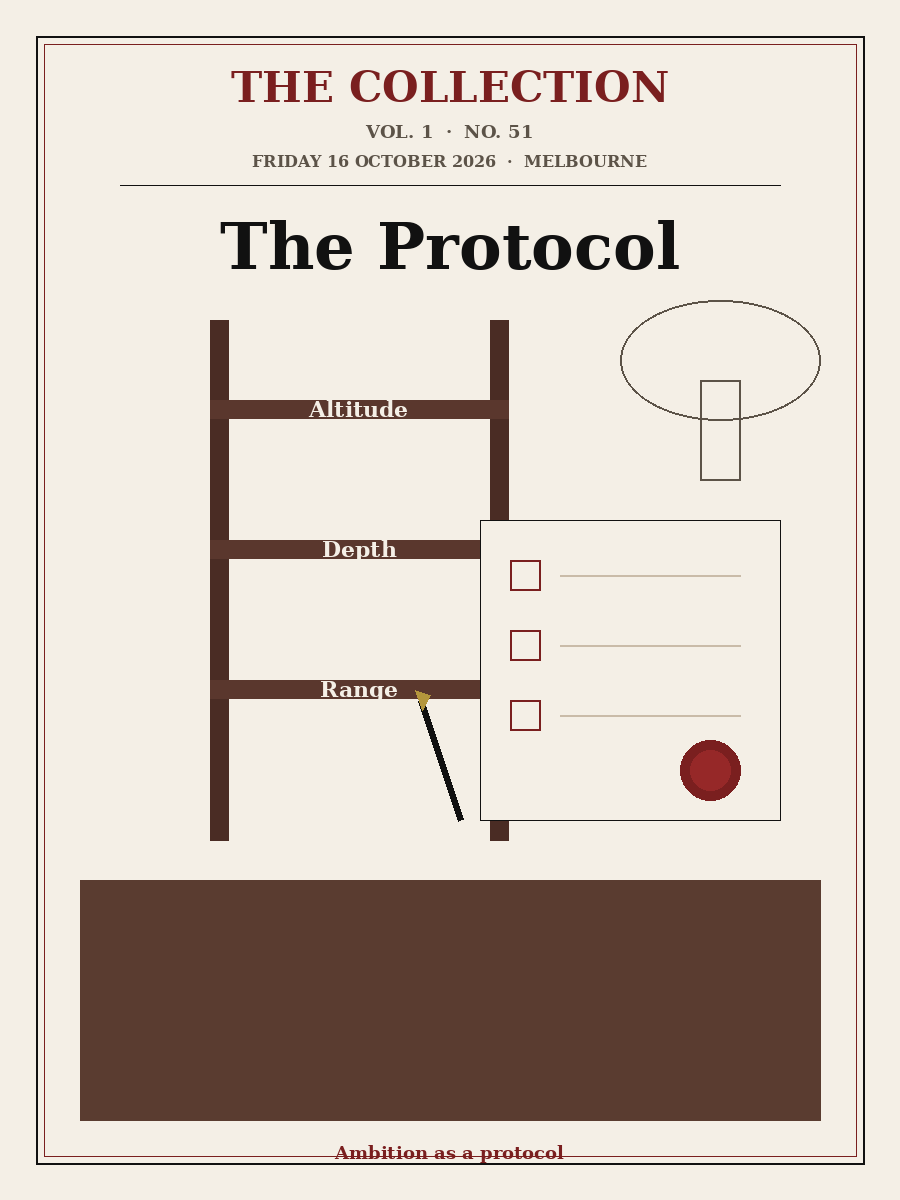
They called the agent lazy. Ambition was never in the protocol.
Newsletter World, for AK · Melbourne
Thursday’s paper asked what the tokens bought. Overnight the mail moved from the till to the system around it. Every letter worth keeping asks the same thing from a different counter: does ambition and control live in the model’s mood, or in the protocol and the stack that wrap it?
Ken Huang takes Felix Rieseberg’s tutorial on ambitious humans-with-models and turns it into a work-hard protocol an agent can run without being asked. The Architect’s Notebook draws the line between an LLM and an AI system with a refund that should never have cleared. Pragmatic Engineer visits Ramp’s internal Glass and notes Stripe’s Harbor, both built in-house when vendor tools were already fine. The Sequence and The Stack argue that every layer can win as a complement, and that every scrap of context an agent acts on should arrive with a contract attached.
Ambition as a mood fails under load. Ambition as a protocol does not.
A short aside from Every.to’s free preview of “How Codex Happened”: Codex Cloud flopped, a reported $3B Windsurf deal fell apart, Claude Code had been running away, and a tiny team then built an app to 40+ million users and remade OpenAI. The remainder is subscribers-only; the stand leaves that unread. Friday takes the kiosk window. Thursday’s Receipt moves onto this week’s rack beside the Frontier, the Egress, the Colleague, the Recall and the Refusal. Thursday asked for the receipt. Friday asks where the protocol lives.
Ambition as a mood fails under load. Ambition as a protocol does not.
04 · The Ladder
Ambition as a mood fails under load
Huang converts a viral tutorial into a protocol an agent can run without being asked.
Collected from Ken Huang, Substack, 15 October 2026
Ken Huang’s letter of 15 October opens with a charge that sounds like a personality flaw: your agent isn’t lazy; it has no protocol for ambition. The spark is a tutorial Felix Rieseberg, an Anthropic engineering lead on Claude, published on 13 October 2026 under the title “How to be more ambitious: A tutorial for humans with models.” The announcement, Huang reports, passed 3.1 million views. Rieseberg names four types of ambition: Speed, Altitude, Depth and Range. Ambition, in that framing, spreads by example rather than by pep talk.
Huang’s move is to stop treating ambition as a mood the model might adopt and start treating it as something you can encode. He converts the tutorial into what he calls a work-hard-protocol skill: seven hard rules, three protocols, four domain playbooks, released as MIT open source. The paid section of the letter carries the install path details; the stand leaves those unread rather than invent them.
Ambition as a mood fails under load. Ambition as a protocol does not.
The point for Friday’s paper is not that every shop needs Huang’s exact skill. It is that the failure mode people call laziness is often a missing protocol. Asking the model to try harder is a mood. Writing the ladder of what “harder” means into something the agent runs without being asked is a system. Thursday counted the tokens. Friday asks whether ambition was ever on the bill.
The model suggested the refund. The system authorised it.
The Architect’s Notebook letter of 15 October is blunt in its title: “An LLM Is Not an AI System.” The model is one component. The failure that makes the case is a refund-bot scenario: the LLM says a refund has been processed, and the surrounding system allows the financial action to proceed. The bug is not that the model guessed wrong about customer service. The bug is that a suggestion was treated as authorisation.
The sentence the stand keeps is the letter’s own: “The model provides intelligence. The system provides control.” The letter mentions four rungs (model, application, workflow, agent), but the unpaid deep dive past that listing sits behind the paywall. The stand labels that unread rather than inventing the climb.
The model suggested the refund. The system authorised it.
Read against Huang’s ladder, the till and the protocol are the same problem from opposite ends. Ambition without a protocol looks like laziness. Authority without a system look like a refund that should never have cleared. In both cases the model did what models do. The missing piece was the wrapper that decides what counts as action.
The vendor tool was fine. The company still built its own.
Pragmatic Engineer’s free bonus of 15 October walks through Ramp’s internal “Glass,” described as an internal Lovable. Gergely visited a four-person Glass team. Ramp has since launched Glass as an external product billed as “An AI workspace where knowledge compounds.” The letter describes connectors into internal systems, a marketing CRM with more than 50 fields, and Glass onboarding as part of new-hire onboarding. Early build notes in the same letter also mention two engineers; the stand prefers the visit to the four-person team as the clearer figure for how small the crew was.
Beside Glass sits Stripe’s Harbor: an AI-assisted prototyping tool built by a single engineer in about six weeks. The reasons the letter gives for building in-house rather than waiting on vendors are plain: a tiny investment, safer handling of internal data, an existing design library, refusal to wait on vendors, and the upskilling of engineers who build the tool.
The vendor tool was fine. The company still built its own.
None of this is an argument that every company should reinvent the loom. It is an argument that when internal data and the design system are the product, the protocol of work may belong inside the company. Thursday asked what the tokens bought. Friday notes that some shops spend tokens on a tool they own.
The model is one layer. The dinner is the product.
The Sequence’s free Opinion 951, “The Whole Stack Wins,” argues that all layers can win as complements rather than as a single winner-take-all model. Consumer agents, it says, shift the game from attention to responsibility. It cites Meta Muse on 8 September 2026 and Instinct’s $1B raise at a $10B valuation on 28 September, as Sequence reports them. On the enterprise side it points to a completion loop, with Sierra’s outcome pricing as an example, Databricks Unity Catalog extending toward agents, Cloudflare’s work on agent identity and wallet, and what it calls an activation frontier.
The Stack Runtime of the same day, by Tom Krazit, grounds the same idea in data contracts. H-E-B data engineer Aditya Ranjan argues that agents need freshness and lineage contracts: “Every piece of context an agent uses to justify an action should arrive with a small contract attached.” The Stack’s figures for the week: Microsoft’s October Patch Tuesday listed 1,408 CVEs, against 1,130 for all of 2025; JPMorgan’s AI spend, per CFO Barnum, is closer to $700M a year than to the $2B figure that had been circulating. The stand uses only the numbers these letters supply.
The model is one layer. The dinner is the product.
Put beside The Till and The Glass, the complement is the wide shot. Control is a system. Ambition is a protocol. Internal tools are sometimes the right layer. And the context an agent acts on is not free-floating intelligence; it is evidence that should arrive under contract. The model is one course. The dinner is what the company ships.
Ambition as a mood fails under load. Ambition as a protocol does not.
Standing Orders
Four rules for this issue
I
Put ambition in a protocol the agent runs without being asked.
A mood fails under load. Encode Speed, Altitude, Depth and Range as rules the agent follows, not pep talks it forgets.
II
Never let a suggestion become an authorisation.
The model provides intelligence. The system provides control. A refund-bot that clears money on a sentence has no till.
III
Prefer an internal tool when internal data and design systems are the product.
Vendor tools can be fine. Glass and Harbor show when a tiny team still builds its own: safer data, existing design libraries, engineers who learn by shipping.
IV
Attach a freshness and lineage contract to every context an agent may act on.
Every piece of context used to justify an action should arrive with a small contract attached. No contract, no action.