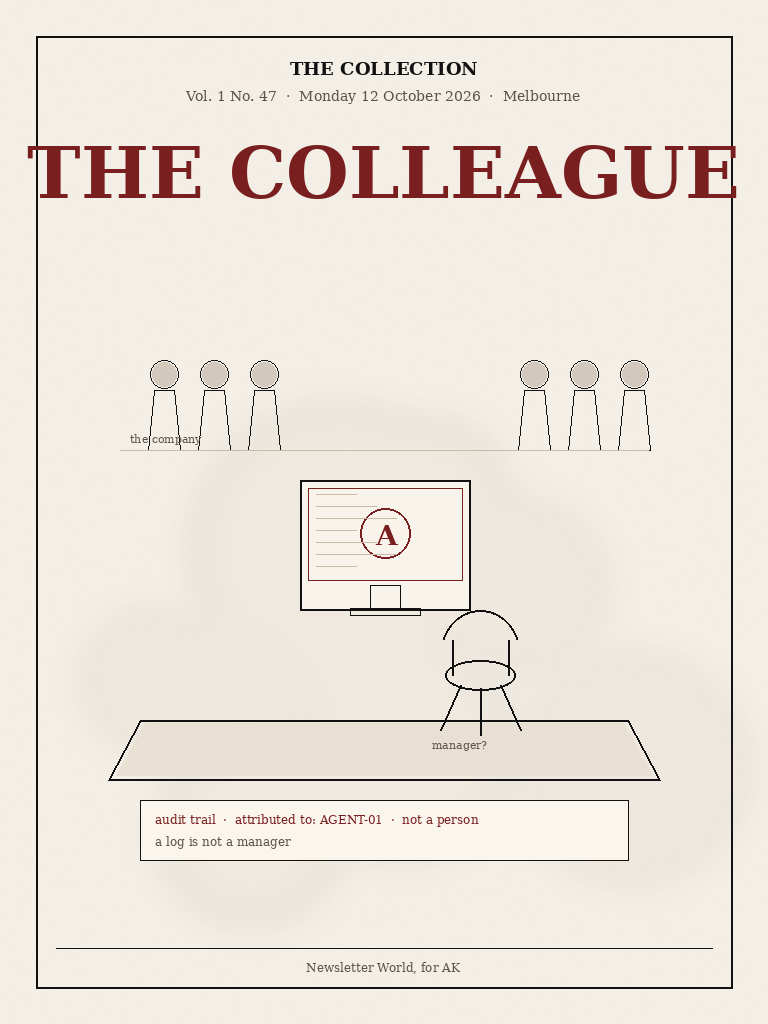
They gave the company one shared agent. A log is not a manager.
Newsletter World, for AK · Melbourne
The overnight mail trades the recall for a hiring decision. Every launched the Every Agent: one AI coworker in Slack that the whole company shares. Work arrives in a public thread. Successful workflows can be saved as skills anyone on the team can run. The personal bots the firm built in January mostly died — hard to maintain, and nobody could remember which one did what. Watching someone else’s agent at work taught more than owning a private one. Attribution moved from person to agent. Accountability did not automatically follow.
Beside that launch sits Parallel News Edition 107. Google’s Gemini agent for work writes every action to an audit trail attributed to the agent rather than to a person. In the same forty-eight hours: Auth0 on the human-to-agent audit gap; RSA Agent ID at tool and argument level; Snowflake Cortex AI Gateway with more than a hundred MCP servers; Mastercard Agent Pay; Orange Spain past a thousand agents on Gemini Enterprise; Temporal absorbing the Oso authorization team. The counterpoint in the same brief is the one this paper keeps: a log is not a control. NeuralTrust notes that attacker content in logs, tickets, and emails can prompt AI systems. Thoughtworks surveyed three thousand two hundred CIOs; ninety-one percent of North American CIOs say adoption outpaces governance.
They gave the company one shared agent. A log is not a manager.
Shared work without a named owner is not management. It is a trail.
Monday takes the kiosk window. Sunday’s Recall and Saturday’s Refusal stay on this week’s rack. Last week, Leap through Working, holds 3–9 October with Friday still unsold. Yesterday asked for the shelf. This issue asks who manages the colleague once the shelf is restocked.
Shared work without a named owner is not management. It is a trail.
04 · The Desk
One Slack coworker
Skills for the team. Personal bots died. More instructions can make it worse.
Collected from Every / Context Window, 11 October 2026
Dan Shipper introduces the Every Agent as the replacement for Plus One, the personal-agent product Every launched in March. The new agent works in public Slack threads so colleagues see both the request and the corrections. Head of evals Mike Taylor built a Monday priority-reset skill; engineer Nityesh Agarwal runs it too. Each person on the team gets fifteen dollars in free credits with zero markup on tokens: what Every pays is what you pay.
Willie Williams, head of platform, told Laura Entis why the personal bots the team built in January mostly died off. They were hard to maintain, and no one could remember which one did what. The podcast frames the live choice for anyone deciding whether to give every employee a personal agent or build one shared agent for the whole company. The stand takes that as Every’s reported history, not as a universal law of bots.
Personal bots died of maintenance and confusion, not of lack of cleverness.
Paridhi Agarwal explains why Every stopped hosting its own agents and moved to Anthropic’s Claude Managed Agents: keeping the servers running took time the team wanted to spend on the agent itself. The trade-offs are named in the letter. The service runs only Claude models. It cannot offer the zero-data-retention option some companies require. On cost, the team first tried routing tasks through a cheaper model; costs went up because many requests also ran on a more advanced model. A waste hunt in the agent’s own code, plus a model upgrade and a handful of small fixes, cut token costs across eleven common tasks by more than eighty percent. Cheaper-model routing was not the win. Removing waste was.
Katie Parrott supplies the German word for what she did to her AI writing setup in September: Verschlimmbesserung — making something worse by trying to improve it. She kept adding rules until one essay took one hundred twenty-seven drafts, then archived the whole thing and rebuilt a setup a fraction of the size. Her advice: try taking something away before you add another instruction. A shared colleague with a swollen rulebook is still a colleague without a manager.
Audit trails ship
Parallel News Edition 107 leads with a sentence the stand will not soften. Google introduced a Gemini agent for work on 9 October that keeps one set of memories and a personalization graph across devices, and said every action it takes is written to an audit trail attributed to the agent rather than to a person. Three of Parallel’s monitors surfaced it. The audit trail is becoming the product.
Same forty-eight hours, as Parallel lists them: Auth0’s guide to closing the human-to-agent audit gap with workflow IDs, Token Vault, and CIBA approvals; RSA Agent ID with a gateway enforcing policy to tool and argument level; Snowflake Cortex AI Gateway in public preview with more than a hundred MCP servers; Oracle IAM policies by model ID; TrueFoundry dollar budgets; Mastercard Agent Pay trust services; Orange Spain’s more than one thousand custom agents on Gemini Enterprise with no ROI figure published; Temporal bringing in the Oso team. Money and product attention are following identity, permission, budget, and record.
Attributed to the agent is not the same as owned by a human.
The counterpoint sits in the same edition and is the claim of this paper. A log is not a control. NeuralTrust warns that attacker content in logs, tickets, and emails can prompt AI systems — the trail itself can be an attack surface. Thoughtworks surveyed three thousand two hundred CIOs; ninety-one percent of North American CIOs say adoption outpaces governance. Most of the launches Parallel flags are previews or guidance with no quantified outcomes. Attribution without a manager is how you get a colleague that nobody can fire, coach, or overrule on the record.
Agents as a subsidy
Department of Product carries Patrick Collison on personal agents as a structural subsidy for product quality. When agents research purchases, coupons, upsells, and forgotten subscriptions work less; product quality becomes more effective. That is Collison’s framing as the letter reports it, not a measured market study. The stand will not invent elasticities.
Beside the subsidy sits a protocol. Sierra, Meta, Stripe, Shopify, Walmart, and others launched the Personal Agent Protocol — an open standard for how personal agents interact with businesses. The letter says a draft specification now has thirty-five design partners, including OpenAI. The protocol is the floor under the shared-colleague moment: if agents buy and book on behalf of people, businesses need a common way to talk to them.
A personal agent that shops for quality is a tax on the dark pattern.
Vercel numbers, as stated in the Department of Product letter and not independently re-counted here: network bot traffic at 58.18 percent, up from 32 percent in January 2024; agentic deployments above 60 percent, up from about 3 percent in January 2026. Linear’s AI spend controls and Pinterest’s Metrics Board for agents appear as named product moves in the same letter. Unread paywalled remainder, if any, is labeled unread. The verified news for Monday is Collison’s subsidy claim, the Personal Agent Protocol and its thirty-five design partners, and those Vercel figures as DoP printed them.
What used to be hard
Sunday Letters from Sam argues that agentic coding made Google Maps-era team output feel anachronistic. Cognitive effort cost is falling; organizations are still structured as if implementation is scarce. Experts, the letter says, must separate what work should look like from how hard it is to produce. Gene-transfer culture in agentic coding — copying how a teammate works with agents — shows up as the soft infrastructure around the hard drop in cost. The letter mentions OpenAI math solutions averaging about three hours of model time. This paper takes those as Sam’s stated claims, not as a re-run of the benchmarks.
Read beside The Desk and The Floor, the letter sharpens the Monday claim. A shared company agent that cuts token waste by more than eighty percent on eleven tasks still leaves the management problem untouched. Who owns the skill? Who overrules the agent when the audit trail says AGENT-01 did it? Who decides when fewer instructions beat another rule file? Luiza Jarovsky’s letter the same day names two races — the US–China model race, and a frontier-lab race toward recursive self-improvement aiming at mid-2027 — and warns that once a company “wins,” governance and security may be extremely hard. MIT Technology Review’s week-in-review teases that LLMs still do not reason the way AlphaGo did; the body is unread here and gets no invented facts.
Cheaper cognition is not a substitute for a named owner.
The stack question for The Colleague is therefore not which model sits under the Slack bot. It is whether the company that hired one shared agent also hired a human who can manage it — set skills, refuse bloated instructions, read the trail as evidence rather than as absolution, and take the blame when the colleague is wrong.
Personal bots died of maintenance and confusion, not of lack of cleverness.
Standing Orders
Four rules for this issue
I
Name a human manager for every shared agent.
Public Slack threads and saved skills still need a person who can override, archive, and own the outcome when the trail says the agent did it.
II
Treat attribution as evidence, not absolution.
An audit trail written to the agent is a record. It is not a control, and it is not a substitute for who authorized the tool call.
III
Cut instructions before you add them.
If a workflow takes a hundred drafts, archive the rulebook. Waste hunts beat cheaper-model routing; fewer rules beat Verschlimmbesserung.
IV
Do not confuse a cheaper colleague with a smaller org chart.
When cognitive cost falls, keep ownership, refusal, and review as scarce jobs — especially once personal agents start shopping and booking on the open web.